Showing posts with label composition. Show all posts

Tuesday, January 8, 2013

Improve your darwing and painting - the value of the small sketch

I can't stress enough the value of working up a small sketch (thumbnail size 1.5 inch by 2 inch or more) in order to develop better paintings... even when you are working from life or outdoors Plein Air style.
Working small freely enables you to think about the very basic composition re: lights and darks, shapes and placement of major forms.  That is what was taught 'Old School'. Just using a 2B pencil or simple black wash you build a visual fluidity and eventually a rapid understanding of exactly what you are looking at.
Somebody said once "The sketch promises everything and delivers nothing "--- not so fast - It delivers plenty.

Here are a few small thumbnails by Mucha done on toned paper with a little pastel for some of his murals
These were done as background studies for a sci fi TV film proposal for a Hasbro toy


The next step is to bring up your idea to a more detailed small painting -about 3" x 6" - to work out the color and discover how much you don't know about your subject...i.e. more studies..definitely Old School


Wednesday, December 19, 2012

Improve Your Painting - plotting the lights and darks


One of the early lecture lessons in Lorser Feitelson's painting class at the Art Center School was analysing how the masters plotted out the lights and darks in their paintings.
Who better to look at than Caravaggio.  Here is breakdown of   'The Crucifix of St. Peter."


Desaturated to reveal the grey scale

Reduced to three values
 - light - middle - dark

 You can rotate your value study 180 or 90 degrees and flip back and forth to isolate your view to lose the subject matter and concentrate on value spotting.  Does it work in all directions?  One quick studio method is to hold up a small mirror to your eye and view your composition while in the process of painting or drawing..The errors usually leap right out at you. See other example at Sundblom.

Let's use the three major values dark - light - and middle and work with them from now on to put together small thumbnail sketches.

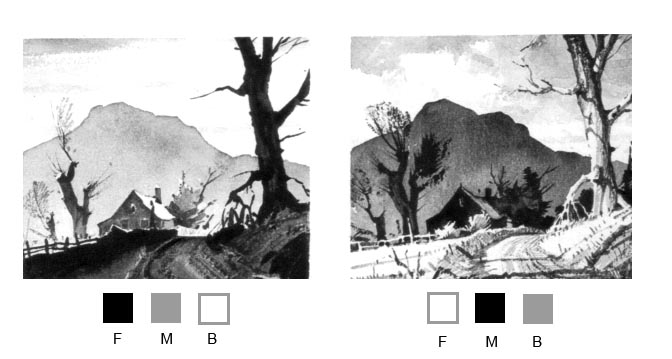
 I have below some cuts from Ted Kautzky's terrific book on watercolor 'Ways with Watercolor' still available.
 I added the value blocks Foreground, Middle, and Background with the appropriate value arrangement to help you design the same pictorial elements you see on site (or photographic reference) and create an interesting painting.

I hope that simplifies the constant struggle to make your work better and better - when in doubt -KISS
"Keep It Simple Stupid"

Tuesday, December 18, 2012

Old school painting practice..copying the masters


Feitelson also advocated copying old masters after studying the composition and brushwork of old masters such as Frans Hals.
Frans Hals. Gypsy Girl. 1628-30. Oil on wood, 58 x 52 cm. Musée du Louvre, Paris.
Malle Babbe, c.1630. Oil on canvas, 75cm by 64cm. Staatliche Museen, Berlin


Below are the studies done in his class at the Art Center School.
(Close but no cigar) 
Valuable lessons in time management and brush technique.
I regret that I did not photograph these exercises with greater care.