Showing posts with label illustration. Show all posts

Tuesday, June 18, 2013

Improve your drawing part 3 - Drawing Animals From Life Or Photos

Most beginning students find drawing animals difficult as they usually like moving around.
If you find a good photo you can practice analyzing the form unfettered by a restless subject...Sleeping dogs need not apply..
Below are a few quick studies that were used for some gouache paintings done for the original owner of the Provence Restaurant Jean Michel and his lovely wife. They passed them on to their friends and neighbors at Coach Farms in Connecticut. 

Find the forms the shapes of the animal takes naturally...rectangle, cube, egg, and see if it fits.  The body parts are naturally divided into symmetrical halves.  Use this natural dividing line to hone your observational skills and get the form down on paper or canvas with solid authority.

look for the center-line down the body and head
 gouache 4 x 7

best dog Tim - 3.5 x 7  goauche


Roping steers -Cody, Wyoming - oil 8 x 11
these blue-lines were preliminary motion studies for an animatic


adding the thick and thin lines by pushing and pulling your pencil helps the feeling of action and the fur of the subject
by using straight lines against curves helps give a little punch to the forms

Thanks for stopping by and see you next time..GL

Wednesday, April 10, 2013

The Art Center School circa 1960-1963

I recently posted a shout-out to one of my closest friends from the Art Center, Fred Pfeiffer, illustrator,whose career ended much too soon by his own hand.  At this age we are starting to loose our pals at an increasingly rapid rate.  Nostalgia took over while digging up as much as I could find from that period to provide some  back story to a dedicated site of his work FredPfeifferArtist.blogspot.com by two really avid fans Courtney Rodgers and Scotty Phillips. 
I thought it might be of interest to some still around as well as to those younger to what it was like at the former building on West Third Street in Los Angeles.

A later photo of the buildings on West Third


Lorser Feitelson
Lorser taught painting  history and technique starting generally with a short lecture and then an open session for your own project.  He encouraged younger painters to copy master paintings for technical understanding


Harry Carmean - drawing and anatomy


An accomplished draftsman, Carmean emphasized careful analysis of the human form.  The texts were Bridgeman and Peck.  Live models were naturally posed for varying lengths of time.  Conte crayon and newsprint pads were generally exclusive materials for these classes.


Morgan Henninger - Advanced Illustration class
 Assignments were given out a week in advance and the crits lasted most of the session...
Do not ever be late...(Deadline of Death)
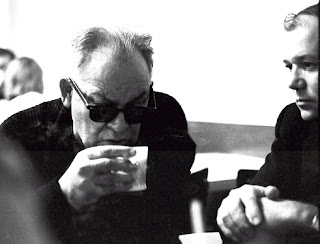
Kaminski and Ted Youngkin at coffee before morning classes
 Typical studio class


 Paul Sousa with I believe one of the Hubner twins
taken from an Art Center Catalog

preparing a board
 studio session during break


 Roommate John Demming and my truck at our shared studio on North Cahuenga
Check out the price of gas...1962


During our last year at the center we found a muddy lot on Franklin and thought up the idea of a rope pull between the Advertising Design Majors and the Illustration Majors.  The prints below were scanned in from photostats and have lost a great deal of detail.  Below are the art directors and I believe it was pretty much an exhaustive draw as we were all laughing so hard..


 The end of the day when the Blue visited the Brown

 Sandy and Timmy

Future Mad Men around 1963-64
If anyone out there has anything to contribute to this section I would love to hear from you...GL

Sunday, April 7, 2013

Thomas P. Quinn - Brushwork, and then some..great example of confident painting style

This gouache illustration for Field & Stream by Thomas Patrick Quinn Jr. dates from 1964...This is really as good as it can get for confident brushwork - lush and creamy style..Tom was a classmate at the Art Center School and brief roommate when we were all at the old Third Street studios.  Regrettably this style of illustration was slipping into oblivion with few exceptions ( John Berkey the most accomplished among them..) Magazine illustration was about to die almost completely in a few years and advertising was rapidly moving into photography snapping the ambition of fairly well trained graduating illustrators.

             Click to enlarge...!


   When the mid sixties hit (Mad Men plus) a lot of really good people dumped out..Cooper Studios
who had most of the top illustrators and most of the top business for all of the country went down.
For the next decade everyone scrambled to pick up what they could...paperbacks, spot drawings,
packaging..whatever.  Reps specialized and some did not always cut you the best deal...keeping major shares for themselves as you rarely saw the invoices.  I was working at J.W.Thompson as a sketch artist on the Ford account doing gouache 24 sheet (bill board) comps for the new Mustang and filling in on other major accounts.  What you see on 'Mad Men' was pretty much it at the time with the exception that I did not see a lot of in house drinking but everything else was common... the AD's and writers only hired good looking women who came from the Seven Sisters (Smith, Wellesley etc) as their secretaries. All others to the typing pool and media.  Assistant art directors were hired at about $60 a week and worked the bull pen for about 3 or 4 months and then be assigned to an AD.. no raise for a year and then if you were lucky got about a grand more per year.  I had a place on Prince Street in the village at the time and occasionally a married AD would ask for the keys to my place during lunch...That was never going to happen I am happy to say..there wasn't much they could do about it as the illustrators were needed for presentations.

Below is a small sketch by John Berkey who regrettably is no longer with us.


Wednesday, January 9, 2013

Improve Your Painting -The Value of the Small Sketch - part 2

Working small ... 3"x5" offers a lot of benefit to your development as an artist and thinker.
First, they get a lot done in a short time..They also usually wind up set aside and eventually rediscovered as nice little paintings - real examples of your true handwriting...

gouache study

gouache study
gouache study - Maryland

gouache study - Inlet Chester River - Maryland

oil study - Vermont

gouache study - Spain

Tuesday, January 8, 2013

Improve your darwing and painting - the value of the small sketch

I can't stress enough the value of working up a small sketch (thumbnail size 1.5 inch by 2 inch or more) in order to develop better paintings... even when you are working from life or outdoors Plein Air style.
Working small freely enables you to think about the very basic composition re: lights and darks, shapes and placement of major forms.  That is what was taught 'Old School'. Just using a 2B pencil or simple black wash you build a visual fluidity and eventually a rapid understanding of exactly what you are looking at.
Somebody said once "The sketch promises everything and delivers nothing "--- not so fast - It delivers plenty.

Here are a few small thumbnails by Mucha done on toned paper with a little pastel for some of his murals
These were done as background studies for a sci fi TV film proposal for a Hasbro toy


The next step is to bring up your idea to a more detailed small painting -about 3" x 6" - to work out the color and discover how much you don't know about your subject...i.e. more studies..definitely Old School


Wednesday, December 19, 2012

Improve Your Painting - plotting the lights and darks


One of the early lecture lessons in Lorser Feitelson's painting class at the Art Center School was analysing how the masters plotted out the lights and darks in their paintings.
Who better to look at than Caravaggio.  Here is breakdown of   'The Crucifix of St. Peter."


Desaturated to reveal the grey scale

Reduced to three values
 - light - middle - dark

 You can rotate your value study 180 or 90 degrees and flip back and forth to isolate your view to lose the subject matter and concentrate on value spotting.  Does it work in all directions?  One quick studio method is to hold up a small mirror to your eye and view your composition while in the process of painting or drawing..The errors usually leap right out at you. See other example at Sundblom.

Let's use the three major values dark - light - and middle and work with them from now on to put together small thumbnail sketches.

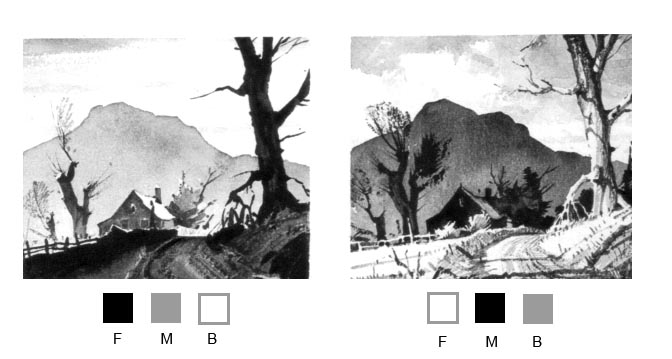
 I have below some cuts from Ted Kautzky's terrific book on watercolor 'Ways with Watercolor' still available.
 I added the value blocks Foreground, Middle, and Background with the appropriate value arrangement to help you design the same pictorial elements you see on site (or photographic reference) and create an interesting painting.

I hope that simplifies the constant struggle to make your work better and better - when in doubt -KISS
"Keep It Simple Stupid"

Friday, December 7, 2012

The 8 best ways to improve your drawing


There must be a gazillion books and blogs regarding drawing but this series of posts is going to try to pull together and boil down the key approaches towards improving your drawing.
  1. Surround yourself with really good examples of great drawing.   
  2. When you look at your subject ask yourself "what is it the most?"
  3. Establish a vertical line (plumb line) mentally or even visually next to the subject.
  4. Find and fix in your mind the negative space or spaces that exist surrounding your subject.
  5. Understand what you are looking at...Think about the subject in the round or cross-section.
  6. Use your line or mark to express what you see..thick and thin line - straight and curved.
  7. Look for the opposite surface visible from the surface you are beginning to render with your line and consider that your new line will amplify the total form. 
  8. Follow the form surface with the shadow lines or texture.
The following books are highly recommended and cover all of the above in great detail..

The Vilppu Drawing Manual...(Excellent start and Art Center Graduate)
Bridgeman's Complete Guide to Drawing from Life


Loomis pen and ink

Oberhardt

Mucha


Paul Kley - pen and ink

Kollwitz


Mucha